
Aerial Thermal Imaging
See temperature patterns that visible imagery alone cannot show.
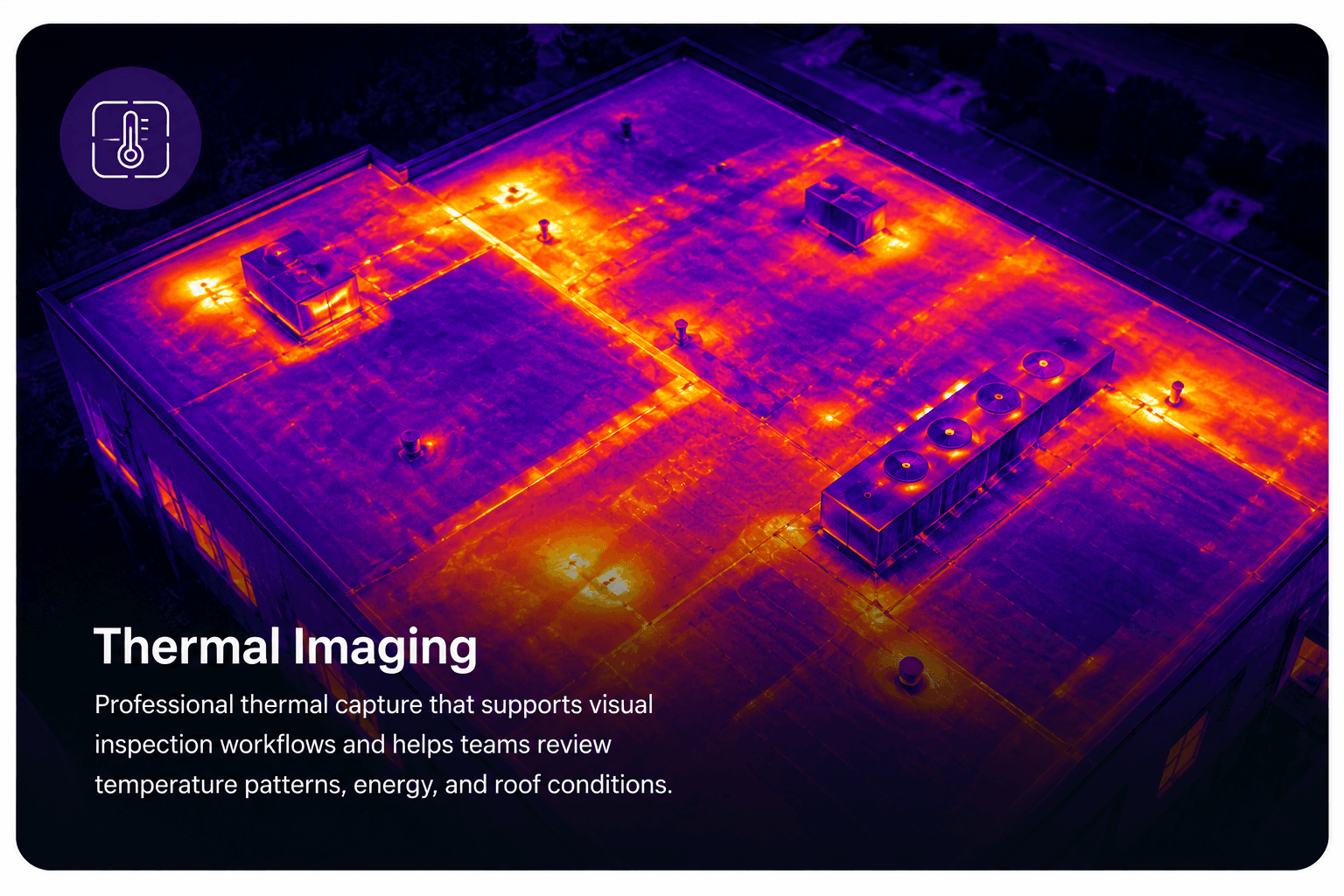
Elevated Drone Services pairs professional infrared imagery with high-resolution visible photographs to document thermal patterns across commercial roofs and properties throughout Central Florida.
- Professional 640 x 512 thermal imaging
- Autel EVO II Dual 640T V3
- Over 10 years of roofing-industry experience
- Paired thermal and visible documentation
Pricing is customized based on property size, inspection goals, flight conditions, imagery requested, reporting needs, travel, and site complexity.
Most standard thermal documentation reports are delivered within 24-48 hours after suitable data collection. Complex projects or customized reporting may require additional time. Rush options may be available when scheduling permits.
A different layer of property information
An infrared camera measures emitted surface-temperature patterns. It does not see through roofing materials or directly detect water. Observed patterns may indicate areas that warrant closer evaluation, but they are not a definitive diagnosis on their own.
Thermal and visible images work together
Thermal View
Infrared imagery shows relative surface-temperature differences and can help reveal thermal patterns that may not be apparent in a standard photograph.
Visible View
A matching visible image provides roof, equipment, penetration, seam, flashing, and location context for the thermal pattern so the observation remains grounded in what can be seen on site.
The strongest documentation pairs a thermal pattern with its matching visible location and a clear explanation of the inspection conditions and limitations.
Reliable thermal documentation depends on the conditions
Useful roof thermal imaging depends on several factors. Late-day or evening inspections are often useful after the roof has absorbed solar energy, but the correct timing depends on the roof system, weather, property, and inspection objective. Not every roof or every day is suitable for thermal inspection.
- Adequate solar loading and temperature change
- Appropriate inspection timing
- Dry roof and surface conditions
- Low or manageable wind
- Suitable cloud cover and weather
- Roof material and assembly
- Surface emissivity and reflectivity
- Safe airspace and site access
Suitable property types
Some reflective, highly conductive, wet, shaded, or unevenly heated surfaces may limit interpretation.
How a thermal project works
01
Define the objective
Review the property, roof assembly when known, areas of concern, desired documentation, and how the results will be used.
02
Evaluate conditions
Review weather, recent rainfall, solar loading, wind, airspace, site conditions, and the most appropriate flight time.
03
Capture paired imagery
Collect thermal and visible images from consistent viewpoints while documenting relevant environmental conditions.
04
Organize and report
Prepare image comparisons, observations, limitations, and recommended next steps in the selected deliverable format.
Expected scheduling and delivery timing will be confirmed with the quote.
Possible deliverables
- Radiometric infrared images when applicable
- Matching high-resolution visible images
- Thermal and visible comparison layouts
- Annotated areas of interest
- Roof or property overview imagery
- Recorded inspection conditions
- Clear observations and limitations
- Downloadable professional PDF report
- Recommendations for closer evaluation when appropriate
Add thermal context to commercial roof documentation
Thermal imaging can be included with a commercial roof drone inspection when the property, roof system, weather, and timing are suitable.
Service area
Elevated Drone Services provides aerial thermal imaging across Central Florida, including Orange, Seminole, Volusia, Lake, and Brevard counties.
Frequently asked questions
Can a thermal camera see through a roof?
No. An infrared camera measures emitted surface-temperature patterns. It does not provide an X-ray view through roofing materials and cannot see through a roof assembly.
Does a thermal pattern prove that moisture is present?
No. A thermal pattern may be consistent with suspected moisture or another condition, but verification may require a qualified roofing professional, moisture meter, core sample, or other evaluation.
What time of day is best for roof thermal imaging?
Late-day or evening conditions are often useful after solar loading, but the correct timing depends on weather, roof material, roof assembly, and the inspection objective.
Can every roof be inspected thermally?
Not every roof or environmental condition produces reliable results. Suitability should be reviewed before scheduling so expectations and timing remain realistic.
How is thermal imaging priced?
Quotes depend on property size, complexity, imaging goals, reporting requirements, travel, timing, and site conditions.
Request a clearer view of the property.
Infrared imagery documents surface-temperature patterns. It does not independently confirm leaks, trapped moisture, mold, structural damage, or the cause of an observed anomaly. Additional evaluation or invasive verification may be recommended.